

♦♦[ART] Feathering: Inking to Create Illusion of a Gradient
You’ve probably heard the word “feathering.” Everyone nods like it’s obvious, but the truth is... It's not obvious. Actually, it's kinda confusing. Let's fix that.

What we mean when we say ‘Feathering’
If you’ve sat in on a comic inking demo or flipped through an old How to Draw Comics the Marvel Way, you’ve probably heard the word “feathering.” Hmmm… yeah, feathering. Everyone around you nods like it’s obvious. If only. But don’t let all the nodding heads get you down; most beginners don’t have a clue. I didn’t. Shall we clarify then?
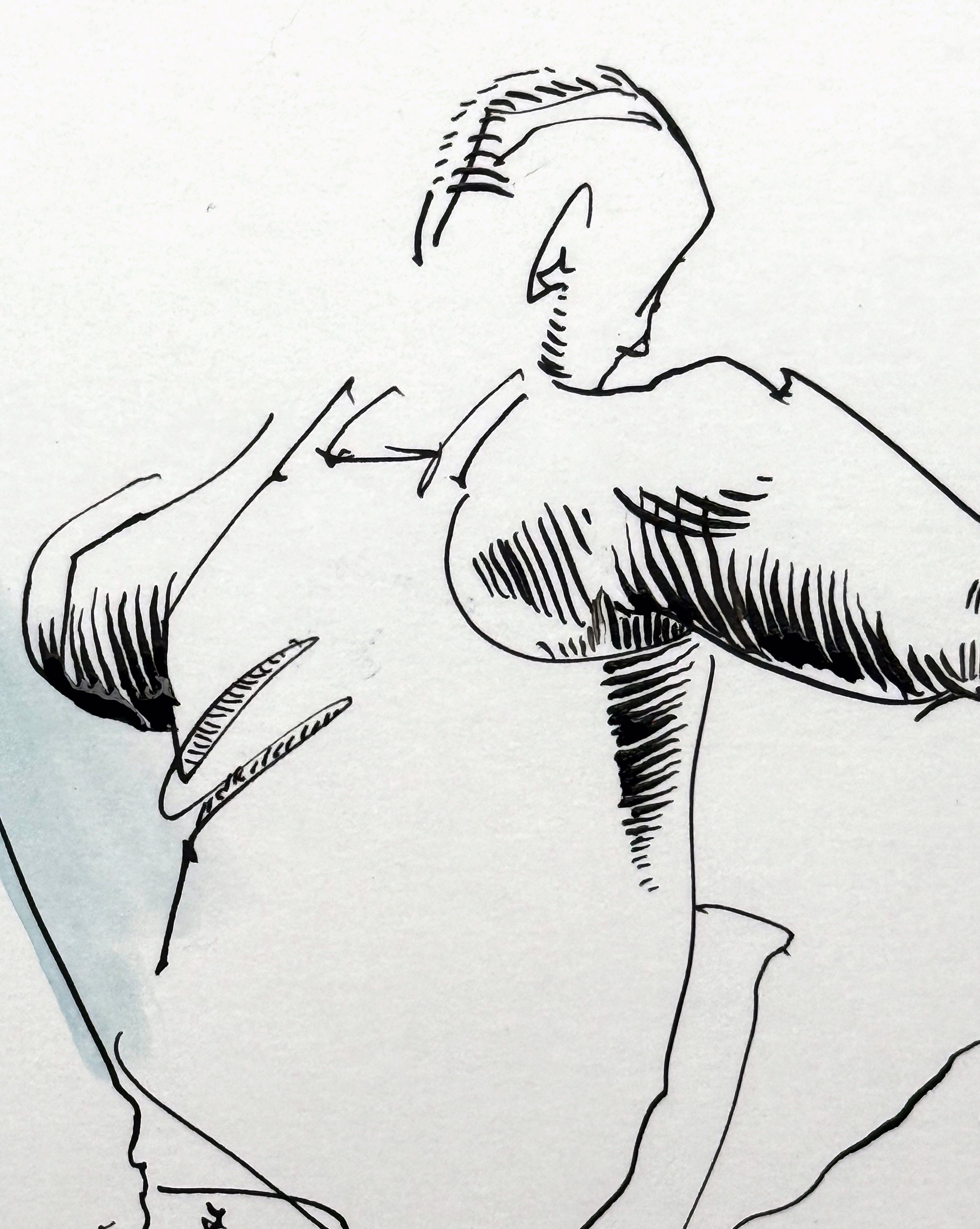
Feathering: Controlled Transition in Black and White
Feathering is a technique used to transition from a solid black area into white space (or lighter tone) by pulling out a series of fine lines. The goal is to create a gradient effect in a medium that doesn’t have gradients.
The lines are parallel or fanning, drawn close together at one end and spaced wider apart at the other.
The “feathers” break up a hard edge of black, creating a softer fade without resorting to a gray wash. (Washes of grey are a no-no in true pen & ink work)
In comics, feathering is often used on muscles, drapery, or curved forms where you want to suggest form turning into light.
Think of it as ink’s version of “blending”—but done with strokes, not smudges or gradients.
Tapering: A Stroke Shape, Not a Technique
Tapering is often confused with feathering, but it’s not the same thing.
Tapering refers to the shape of a single line—thick at one end, thin at the other.
You can taper any stroke, whether it’s part of hatching, contour, or feathering.
Tapering is about pressure control and brush/nib handling.
When we feather, we often taper our strokes—because a sharp point at the end of each line makes the fade cleaner. But tapering on its own isn’t feathering. A lone tapered contour line isn’t feathering; it’s just a tapered line.
How Feathering and Tapering Intersect
Feathering without tapering: You can make feathering lines of uniform width. The transition will be a little more mechanical, but it still counts as feathering.
Feathering with tapering (the norm): Each line tapers to a point, so the fade feels softer and more organic. This is what most comic book artists mean when they say feathering.
So: tapering = a property of the line; feathering = a technique of many lines working together.
Where You’ll See It in Comics
Muscles and Anatomy: To show a bicep curving out of shadow, inkers feather from the black core into the lit surface.
Cloth and Drapery: Feathering softens folds so shadows don’t end abruptly.
Hair and Fur: Feathering can imply texture and light transitions at the same time.
Backgrounds: Used sparingly, feathering can ease transitions from heavy spot blacks into open negative space.
Artists like Joe Sinnott or Mark Farmer leaned on clean, uniform feathering for clarity, while inkers like Klaus Janson used rougher, bolder feathering for energy. Both approaches rely on the same core definition.
Clarity Helps (It aligns our language and our intent)
In class (or in your own practice), when we say “feathering,” we’re talking about a technique for transitioning tones using multiple lines, not just “a tapered stroke.” Keeping that distinction clear means you’ll know whether you’re practicing control of stroke shape (tapering) or control of tone transitions (feathering).
That clarity saves a lot of time when giving or understanding a critique on your luxurious, delicate ink work.
Charles Merritt Houghton
13 November 2025