

♦♦[ART] When 'Camera' Placement Stops Being Technical and Starts Being Narrative
If your scenes and settings look “fine” but unsatisfying, you’re not stuck. You’ve probably just outgrown the question you’re using to judge that drawing. Congratulations, time to level up!

Evolving from “Is Something Obviously Wrong?” to “Does This Say What I Want?”
The hidden skill jumps artists make on their journey from competency to mastery.
Early on, artists learn to ask one essential question:
Is something obviously wrong?
Extra fingers. Broken perspective. A head that’s slightly off center. A room that feels like it’s sliding downhill.
That question is not naïve. It’s necessary.
It’s how beginners learn to tame chaos on the page.
But if you keep asking that question forever, you’ll stall—because at some point the work can be right and still be unsatisfying or wrong in a deeper way.
Real skill jumps happen when the questions change.
Not: Is something obviously wrong?
But: Does this say what I want it to say?
That shift doesn’t happen all at once. It’s a ladder. Take one rung at a time. And camera placement is one of the clearest ways to see it. I say “camera” because in drawing we’re often inventing the shot, there’s no camera involved. But it’s a functional metaphor.
Stage 1: Obvious Errors — “Don’t Be Wonky”
At the first stage, the goal is survival.
You’re just trying to draw a view, a shot, a scene that isn’t obviously broken.
With camera placement, this means:
The horizon isn’t tilted by accident
The perspective roughly works
Parallel objects go to the same vanishing points
The figure doesn’t look ‘floaty’ and detached from the ground
The room doesn’t feel like it’s collapsing
You’re not choosing a shot yet.
You’re choosing a view that holds together.
This is about correctness. And correctness matters, because without it, nothing else can function.
Trying to jump past this stage is a mistake. If the drawing is unstable, any attempt at “meaningful” camera work just creates noise. More importantly, it’s a distraction.
At this stage, not being wrong is the win.
Stage 2: Coherence — “Make It Believable and Interesting”
Once obvious errors are under control, artists usually feel a surge of confidence—and then a new kind of frustration.
Now the drawing isn’t broken. But it’s dull. Or confusing. Or busy. Or weirdly flat.
This is where camera placement starts to feel like a tool.
Now the questions sound like:
Is this angle dynamic?
Does the shot feel convincing?
Is there depth?
Does the composition guide the eye?
You start choosing low angles, high angles, over-the-shoulder shots. You’re thinking about staging and drama.
This is progress.
But notice what’s still missing: intent.
At Stage 2, the camera is chosen to make the image look good.
It’s dynamic. Interesting. Cinematic.
But it’s still neutral.
Stage 3: Aligning Shots to Intent — “Who Is Doing the Looking?”
This is the real jump.
At Stage 3, camera placement stops being about interest and starts being about opinion.
Now the questions change:
Who is seeing this?
What is the emotional position of the viewer?
Is this shot meant to empower, diminish, expose, threaten, protect?
What does this angle feel like to inhabit?
This is where “camera placement” becomes narrative.
A low angle isn’t just dynamic—it can make a character feel imposing.
A high angle isn’t just interesting—it can make them feel vulnerable or judged.
A distant shot isn’t just atmospheric—it can create emotional isolation.
A close, intrusive shot can feel voyeuristic, intimate, or unsafe.
At this level, every shot has an attitude.
The camera is no longer neutral. It has a point of view.
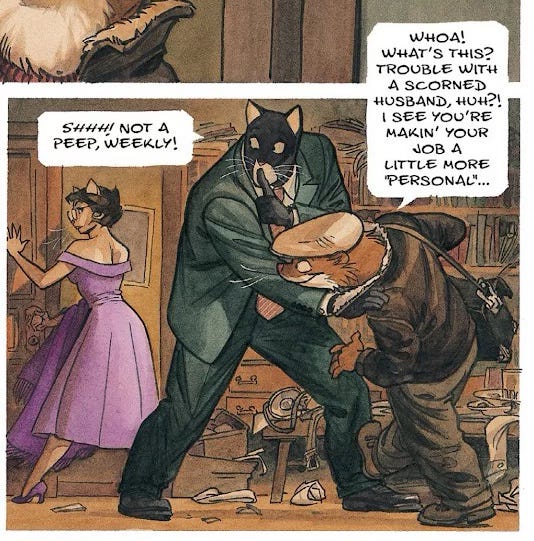
This is where artists begin to think the way filmmakers do—Hitchcock, Orson Welles—or comic artists like Guarnido in Blacksad. The camera isn’t just showing the scene. It’s commenting on it.
The Deathtrap: Starting with Stage 3
Here’s the mistake ambitious artists make:
They try to start here.
They study great cinema. They analyze master comics. They want every shot to carry subtext, emotion, and psychological weight.
But Stage 3 shots are harder to pull off. They require intermediate skills. You better understand horizon lines and vanishing points, and even vertical convergence. This stuff gets tricky. It’s worth it, but it’s NOT beginner fare.
They demand:
Solid perspective
Clear staging
Confident anatomy
Controlled values
Strong composition
If your energy is still being spent just making things believable, adding voyeuristic or psychological intent on top will overwhelm the drawing.
That doesn’t mean studying masters is bad. It’s essential.
But study does not mean deployment.
Build your visual library. Learn what Hitchcock and Welles were doing. Study how Juanjo Guarnido and Frank Miller use framing to create tension.
Just don’t distract yourself from the phase you’re in.
Stay on target.
Staging Your Progression
Here’s the ladder, using camera placement as the example:
Stage 1: Place the camera so the drawing isn’t obviously wrong
Stage 2: Place the camera to create believable, dynamic images
Stage 3: Place the camera to express narrative intent and emotional stance
Each stage builds on the last. None can be skipped.
The mistake isn’t wanting Stage 3.
The mistake is abandoning Stage 1 or 2 before they’re stable.
Reframing Things So You Don’t Overwhelm Yourself
When a drawing stalls, don’t ask how to make it better.
Ask which level you’re actually working at right now.
If the camera feels broken, fix correctness.
If it’s correct but boring, improve coherence and dynamism.
If it’s coherent but empty, clarify intent.
That’s not intuition. Intuition comes from experience. Build experience — don’t do everything everywhere all at once. You’ll short-circuit.
A smooth process is diagnostic.
And diagnostics are learnable.
Closing thoughts
Learning to draw for narrative intent is not a leap. It’s a climb.
Every artist passes through:
Don’t be wrong
Make it work, make it compelling
Make it mean something
If you feel stuck, you’re probably not failing.
You’re just asking a Stage 3 question with Stage 1 tools—or trying to solve a Stage 1 problem with Stage 3 ambition.
Update your self-diagnostic process by asking the right question at the right time.
Then draw.
Charles
Quick Reference documents below for my beloved paid subscribers:
