ARTICLE 1 Perspective Matters: Making Art That Leaps Off the Page
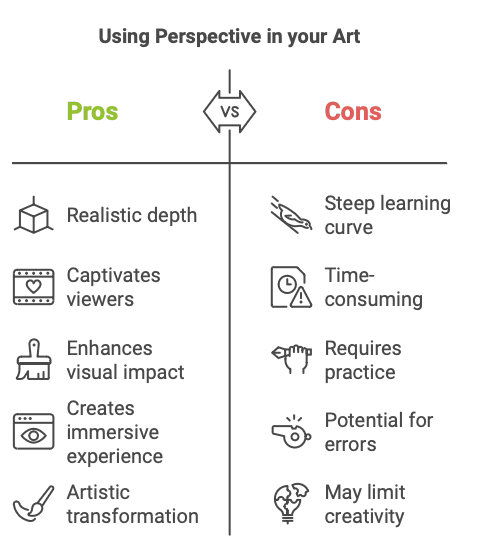
Most artists struggle to make their work feel real. Flat, dimensionless drawings aren't rare. But perspective can help transform any surface into a window to a new world.

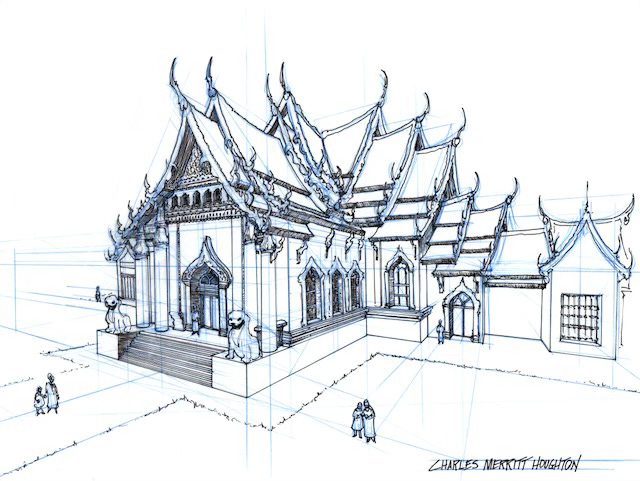
Why Perspective Matters
Creating convincing depth on a flat surface is not just an artistic achievement; it's transformative, shaping our visual perception of the world. Linear perspective, first codified during the Renaissance, turned art from symbolic representation into a powerful tool for capturing the world as we see it. But perspective is far more than just a technical skill—it's the fundamental language of spatial storytelling, at least on flat surfaces. (Mad respect to sculptors and architects, their spatial skills go even further.) Perspective is an artistic skill that can inspire awe and wonder.
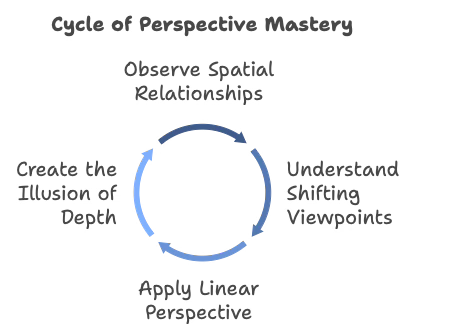
The Illusion of Depth
Our brain processes countless spatial relationships when looking at the world around us. The way a street seems to narrow as it stretches into the distance, how buildings appear to converge toward the horizon, or how a simple box shows three faces from a particular viewpoint are all part of our natural visual experience. Our heads are constantly swiveling and shifting. And each twist and turn is a NEW perspective. (It's true, turning 5 degrees is a new perspective construction.) But if you embrace linear perspective, you can recreate these spatial relationships systematically, turning a flat surface into a window into another world.
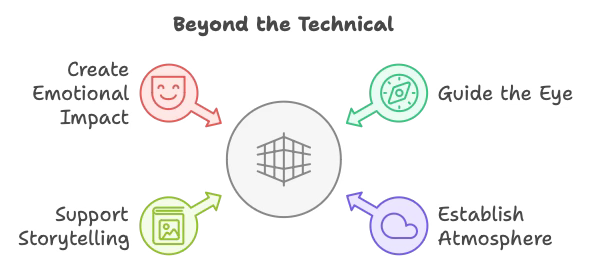
Beyond Technical Accuracy
While perspective is often associated with architectural rendering and technical drawing, its true power lies in its ability to:
Guide the Viewer's Eye: By understanding perspective, artists can deliberately lead the viewer's attention through their composition, creating focal points and visual journeys.
Establish Atmosphere: Applying perspective thoughtfully can create feelings of intimacy or vastness, stability or dynamism, comfort or unease.
Support Storytelling: Perspective choices can emphasize character relationships, highlight critical narrative elements, and convey psychological states.
Create Emotional Impact: A low-angle perspective can make subjects appear powerful or menacing, while a high angle might make them seem vulnerable or insignificant.
The Foundation of Visual Believability
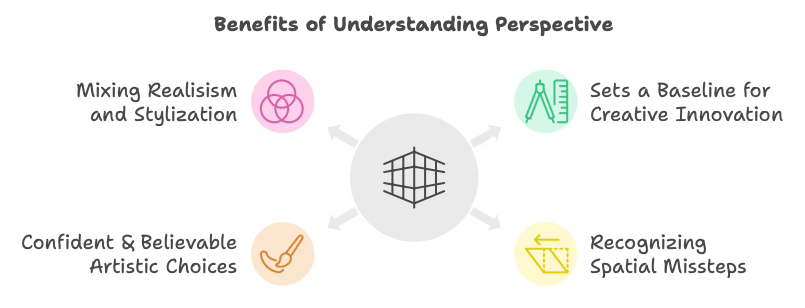
Even when artists choose to bend or break perspective rules, understanding these principles remains crucial because:
It provides a baseline from which artistic decisions can deviate.
It helps artists recognize when and why certain spatial relationships feel "off."
It enables more confident and deliberate artistic choices.
It allows artists to mix realistic and stylized elements convincingly.
Real-World Applications
Understanding perspective is essential across multiple creative fields:
Illustration: Creating convincing environments and scenes
Concept Art: Designing believable worlds and architecture
Comics and Storyboarding: Establishing dynamic camera angles and scene transitions
Animation: Planning scenes and character movements in space
Game Design: Creating immersive 3D environments
Industrial Design: Communicating product ideas through drawings and making things that don't yet exist look real and tangible.
Bridging Vision and Creation
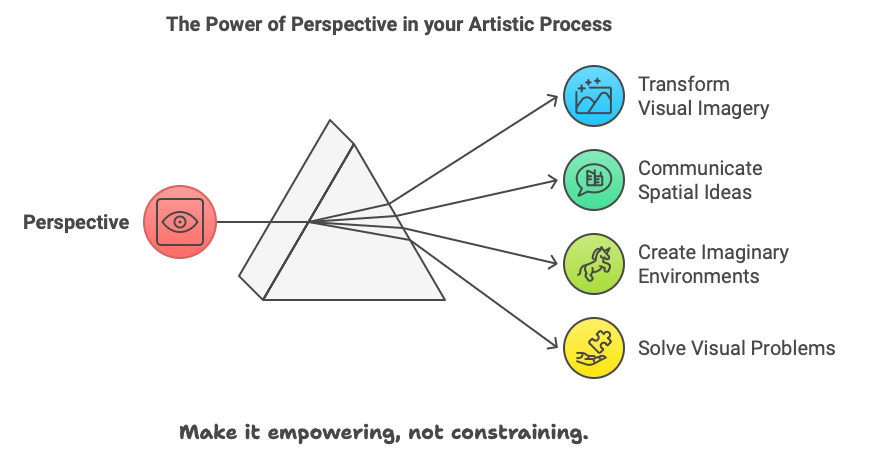
Perhaps most importantly, perspective serves as the bridge between what we physically see and what we mentally imagine. It provides a systematic approach to translating our three-dimensional world onto a two-dimensional surface, allowing artists to:
Transform what you see into concrete visual representations
Communicate spatial ideas clearly to others
Create convincing imaginary environments
Solve visual problems methodically
Moving Forward
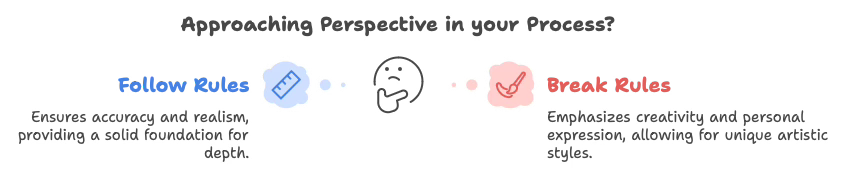
As we explore perspective techniques, remember that mastering these principles isn't about limiting creativity but expanding your artistic toolset. Maybe you've nailed anatomy and tone but need another tool to make your drawings and paintings leap off the page. You can follow perspective rules religiously or break them with intention. As long as it empowers you, the linear perspective is worth practicing.
And practice you must; perspective ain't somethin' you can read and immediately apply. Wish it were, but it isn't. I tried. Linear perspective requires accuracy and focus. It's worth it, but it takes work. Get it wrong. Try again. Get it less wrong. Try again. That's been my experience, and talking to other accomplished artists, I am not alone.
So get drawing. Step 1 - draw what you see. Step 2 will be to add structure to what you see so your viewers will believe it. We'll cover Step 2 in later articles.
Charles Merritt Houghton
3 December 2024