

Does Your Visual Story Flow? Using Lead Room and Sight Lines for Maximum Visual Impact
Transform static panels into dynamic narratives that captivate and lead the reader's eye with subtlety and confidence.

Mastering composition creates immersive storytelling experiences. Two powerful tools of composition are "lead room" and "sight lines." While simple, they can be hard to separate, but when applied, they dramatically enhance readers' engagement with your story, guiding their focus and creating a dynamic flow across panels.
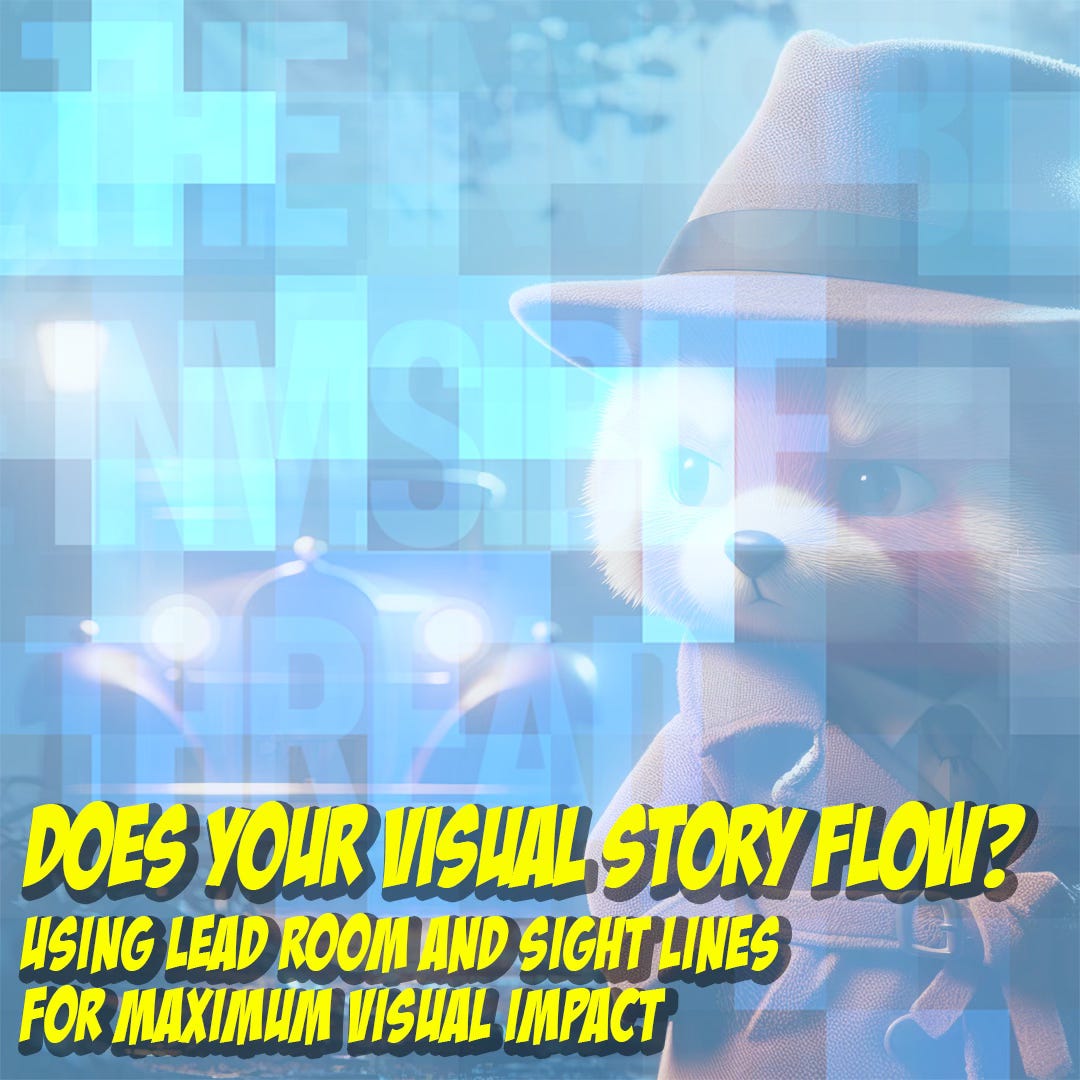
Let's Define them so we can understand what we're starting with:
Lead Room: Also known as "nose room" or "forward space," this term refers to the space in front of a subject moving (in film) or looking in a particular direction. It's crucial for creating a sense of directionality, anticipating what's out-of-frame or in the next panel. Personally, I like the term "lead room" because I don't like the sound of "nose room." It's my totally biased and idiosyncratic preference. However, "nose room" seems more commonly used in the literature of film and cinematography.

Sight Lines are the implied line along which a subject in a composition looks or points, guiding the viewer's attention in that same direction. They are also known as "eye lines" or "directionality of gaze." Sight lines are a powerful compositional tool for directing focus within a scene or across panels on a comic page.

Mastering the use of lead room and sight lines in your comic book compositions can profoundly impact how your story is read. When applied effectively, each technique can enhance the narrative flow, create dynamic compositions, and, most importantly, guide your audience's focus. By understanding and employing both techniques, your mastery will deepen.
Differences and Their Utility
Though both concepts deal with spatial arrangement and direction, they serve distinct purposes:
Lead Room is about spatial anticipation and the suggestion of movement or focus ahead of the character. It adds depth and context to the physical space within the panel.
Sight Lines focus more on the narrative direction and a character's focus in the shot. They guide the reader's eye to pivotal story elements, creating an intentional narrative flow and strategically connecting panels within a page.
Utility as Composition Tools
Employing lead room and sight lines allows comic creators to craft more engaging, visually cohesive stories. They are essential for:
Introducing movement and dynamism into the panels.
Highlighting narrative focus and intent.
Guiding reader eye movement and direction of the read inside a single panel and between sequential panels.
Enhancing the visual storytelling through strategic placement and direction.
Creating a seamless flow that guides the reader through the story naturally, and if necessary, slowing down the read by keeping attention in a panel for longer. This allows the artist to affect the rhythym and speed of the reader's experience.
Actionable Tips
Prioritize Panel Planning: Consider the action and attention flow in your panels. Use the lead room to highlight movement or direction, ensuring adequate space in front of characters. Also, consider the anticipation the space creates in the composition. It's the visual equivalent of foreshadowing. The Writer does this in text and dialogue, and the artist can subtly mirror this using the lead room.
Leverage Characters' Gaze: Direct the characters' sight lines towards the panel's narrative focus or the next panel on the page. This will guide the reader's gaze and create an intuitive flow.
Layout Experimentation: Play with panel layouts to optimize lead room and sight lines. An artist might improve the narrative flow by flipping the panel orientation or nudging the layout.
Silhouette Practice: To better grasp the lead room, practice with silhouettes of characters, focusing on the space in front of them. These characters might be preparing to move or drawn with speed lines or other forms of implied motion. Artists have lots of tricks in their toolbox.
Review Your Flow: Look at your page layouts as a whole. Do the lead room and sight lines create a coherent flow from panel to panel? Adjust as needed to ensure clarity, engagement, and a deliberate narrative pace that reinforces the story, slow in the right parts and fast in others.
By integrating lead room and sight lines into your comic panels, you embrace two powerful tools that elevate your panels and, by extension, the page design and narrative flow. These two techniques are subtly different, and if you consider what your composition needs, you can refine your panels and pages for maximum visual impact. Use both tools and mix with other techniques to craft the most engaging story possible.
Visual Storytelling is a challenging process. Having additional tools can help you optimize your efforts.
Charles Merritt Houghton
18 April 2024