

[INTRO] Why I Break Every Article Into ART, STORY, and BIZ
If you’ve been reading my posts for a while, you may have noticed a pattern: I divide my work into three sections—ART, STORY, and BIZ. This isn’t just a stylistic quirk, it's a strategy... to help you

I make this blog easy to read, or at the very least, easy to decide if a given article is for you. It’s a framework designed to ensure that, regardless of where you are in your creative journey, you know what you’re getting into and whether the article will be helpful to you.
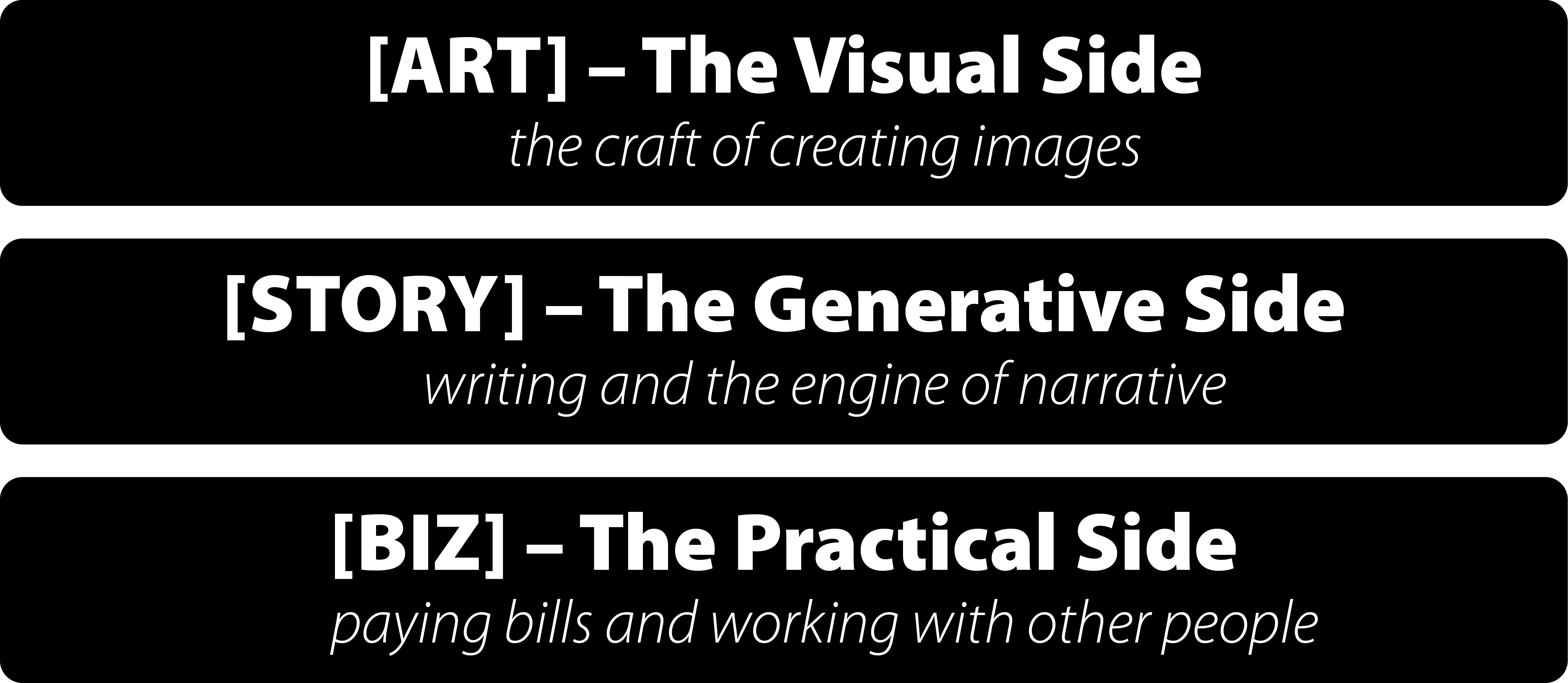
[ART] – The Visual Side
This is where I discuss the craft of creating images. Picture-making is an important skill, and it’s not something that comes naturally. OK, maybe it’s intuitive to start, but it gets damn complex damn quickly.
Drawing, painting, perspective, and inking.
Color theory, page composition, and the visual grammar of comics and illustration.
If it’s about what your audience literally sees on the page or canvas, it falls under ART.
[STORY] – The Generative Side
This section covers the writing and narrative engine behind your work.
Character creation, dialogue, and plotting.
The frameworks and structures that make stories work.
The deeper psychology of why audiences care in the first place.
If ART is what you see, STORY is why you keep turning the page.
[BIZ] – The Practical Side
Finally, BIZ covers the part that too many artists try to avoid: how actually to succeed in the world. To pay bills and work with other people. It ain’t easy, and artists deserve all the help they can get.
Marketing, workflow, and professional practice.
Pitching your work, building an audience, handling contracts.
The small, unglamorous things (like organization, pricing, or deadlines) that make the glamorous parts possible.
Without BIZ, the rest often never sees the light of day.
The Diamonds: A Skiing Story
You’ll notice I also add little diamonds (♦) before each category. That tradition dates back to my days in Colorado, the end of high school, and into university. For those interested, I started in physics, then made a hard pivot to architecture. Colorado is ski country. And if you’ve skied, you know these diamonds aren’t a girl’s best friend. Quite the contrary. They’re meant to warn you when you’re getting in over your head. They indicate difficulty level.
A single diamond (♦) is beginner-friendly. Two diamonds (♦♦) means intermediate—solid footing required. Three diamonds (♦♦♦) is advanced, maybe even expert-level, and not for the faint of heart.
Why do I use them? Because one time, as an ambitious albeit fair-to-middlin’ skier, I made the mistake of dropping down ‘Mary Jane’ at Winter Park—moguls, vertical drops, sheer panic. I was not prepared. I lost a beloved pair of underpants that day.
I don’t want you to feel like that when reading one of my articles. The diamonds are my way of telling you, “This is how deep we’re going. Choose your run.”
Not to Exclude, But to Inform
The point of the diamonds isn’t gatekeeping. It’s the opposite. I want you to know upfront whether an article is pitched at beginners, intermediate creators, or advanced semi-pros. That way, you can choose what matches your current footing.
Sometimes you’ll challenge yourself with a harder run. Sometimes you’ll stick to the basics. Either way, the system is here to guide you, not to shut you out.
That’s the system: ART, STORY, BIZ—with diamonds to mark the level.
Simple, visual, and hopefully functional.
If I’m entirely wrong about the utility of my little system, let me know in the comments. I read ‘em.
Charles Merritt Houghton
25 August 2025