♦♦ [STORY] Multisensory Visual Storytelling: Neuroscience for Comics
Make your readers' experiences so vivid they're swept away. Make them see, hear, smell, taste, and feel every detail as intensely as if they were really there.

Yesterday, I published my thoughts on multisensory storytelling, and it occurred to me that my context applied to how I was writing these articles. But that’s only a small part of my passion. I’m an artist first and come to storytelling later. These ideas apply, but not as directly. So, let’s talk about visual storytelling and neuroscience.
As I said yesterday, Will Storr’s thoughts in The Science of Storytelling, Jonathan Gottschall’s The Storytelling Animal, Paul J. Zak’s findings on oxytocin, and Keith Oatley’s work on the psychology of fiction resonated with me. If immersive storytelling taps into our brain’s capacity to simulate experiences, what happens when it becomes visual? Sensory writing doesn’t only come from words, though; it can also come from the images, pacing, shapes, colors, and angles you use on the page.
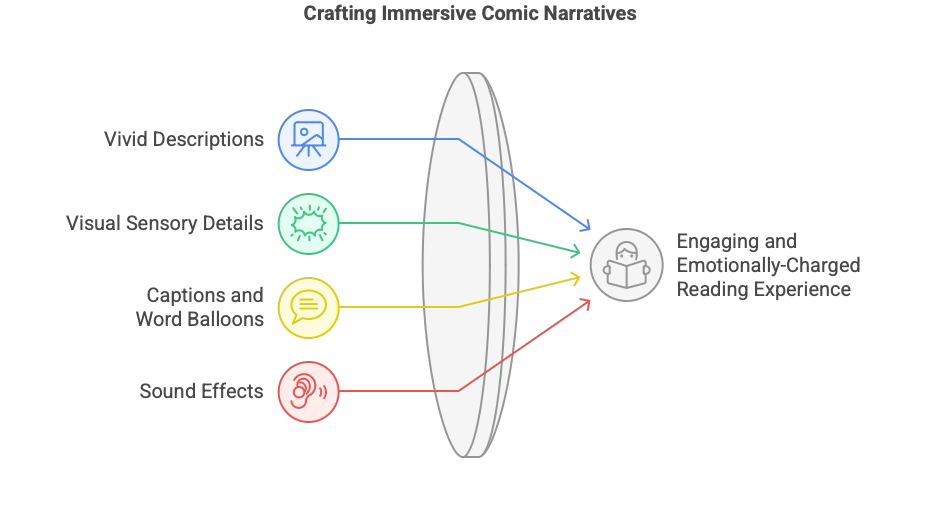
In prose, you rely on vivid descriptions to evoke sensory experiences. In comics, you have an added advantage because you show these sensory details visually and then amplify them through well-placed captions, word balloons, and sound effects. Targeting the brain’s sensory regions with images and text makes the reading experience more engaging and emotionally charged.