

♦[BIZ] Passion vs. Payoff: The Math Behind Creative Careers. Schools and Degrees are options, not requirements.
In 2025, artistic education and dreams require hard math—when creative degrees leave a $100,000 crater after a decade of hustling, passion needs a spreadsheet, a side hustle, and a damn good therapist

Rant Warning: I rant in this post. Pure and Simple. I'm ranting about debt and dreams. If you don't plan to get a degree in art, don't read this. It’s not meant for you. Save yourself the time. Go watch a kittens and puppies video. But if you're considering a 4-year bachelor's degree or a 2-year Master's degree. This is for you.
Gettin’ Real. Return on investment (ROI) is a business term, and it’s time to understand it.
Let’s cut to painful, excruciating chase. You know, when the clippers cut just a little too deep.
ROI (Return on Investment) matters.
It isn't just business jargon. It's real. You need to know it. It's the million-dollar question: for every dollar you sink into a degree, how many come back to you, and how quickly?
The finance folks use fancy formulas like:
ROI10 = (Σ earnings Yr 6-10 – net price × years enrolled) ÷ (net price × years enrolled)
But don't worry—Georgetown's Center on Education and the Workforce (CEW) has already done the math using federal College Scorecard data. Look it up, they have charts.
https://cew.georgetown.edu/30-of-colleges-fail-to-provide-strong-roi-after-10-years/
The Jaw-Dropping Price Tags
Let's talk real numbers here. In 2024-25, here's what you're actually looking at for animation, illustration, and comics degrees (tuition only):
Rhode Island School of Design (RISD): $63,966 per year (that's the highest in the field)
California Institute of the Arts (CalArts): $60,650 (yes, the Disney pedigree costs extra)
Ringling College of Art & Design: $52,600 (popular recruiting ground for big studios)
School of Visual Arts (SVA) in NYC: $51,400
Maryland Institute College of Art (MICA): $54,750
Even the "more affordable" private option, Savannah College of Art & Design (SCAD), still runs $41,130 annually.
Want a public alternative? In-state at Cal State Fullerton will cost you just $7,474 annually, while MassArt in Boston charges $13,200 for state residents ($36,000 for out-of-staters). But let's be honest, world-class art schools are hard to find in public universities. Some are incredibly erratic. One critical professor or department chair leaves, and everything can fall apart. Thems the breaks.
And are you thinking about that MFA afterward? The rates are usually higher, the scholarships rare, and the grants non-existent. If you don't already have an undergraduate degree, add two years of expenses to the four you’ve already sign up for. But don't do it unless you PLAN to teach. No ones care about the art degree. They care about your artistic product.
The Sticker Shock Doesn't Stop There
Beyond tuition skyrocketing 104% faster than regular inflation since 2000 (public universities up 141%, private schools up 181%), there's the housing question.
Private art college dorms typically add another $16,000-$25,000 annually. At SVA, that's $25,400 annually. MICA charges $22,500, while RISD asks for $16,600.
Should you count this cost? Here's a practical rule: Only include what's new money. If you're already renting your place, calculate the difference. But if you're moving out for the first time, that full housing cost is part of your investment.
Since about 43% of U.S. 18-to-24-year-olds live away from their parents, nearly half of the students end up paying these housing costs.
But here’s the reality. You have to pay rent. Many programs only want you to be FULL TIME. They discourage working your way through school. Glad they’re rich. I’m not. So those living expenses really have to be part of your equation. Be honest.
The Hard Numbers
Let's run a quick sanity check on what this all means for your wallet:
The principal: A private art school BFA will set you back about $220,000 ($55,000 × 4 years). A public in-state BFA? Just $32,000 ($8,000 × 4 years).
The monthly payment: On a standard 10-year federal repayment plan at 5% interest, that private school degree means writing checks for about $2,330 monthly. The public school graduate? Only $340 monthly.
The reality check: The median special effects/animation salary is $99,800. And those jobs are hyper-competitive. Currently, the industry is a bloodbath. The Film Industry is hurting. Jobs are scarce. And the AI Revolution means this salary is only going DOWN. Graphic designers average $61,300, while fine artists and illustrators earn around $56,260.
If you're making $60,000, your monthly take-home pay after taxes is $3,800. Subtract that private school loan payment, and you have just $1,500 left for rent, food, and everything else in your life. Did you want a life? If your expenses are too high, ain't no money. No money = No life. (or it's a damned hardscrabble one.)
The low-down? A public university's BFA or certificate can be comfortably managed on a typical starting salary. But that private degree only makes financial sense if you either land in the highest-paying jobs (think feature film VFX, AAA games, or quick promotion to art director) or score serious scholarships.
The national ROI picture confirms this:
After 10 years:
About 60% of U.S. colleges deliver positive value
Around 30% leave typical graduates worse off than if they'd just stopped after high school
(The other 10% didn't have enough data to tell)
After 40 years:
Nearly all schools eventually show positive returns
But the gaps between winners and losers don't disappear
Take Berklee College of Music as a reality check—it shows a negative $100,000 value after a decade. Yes, it eventually turns positive, but not until year 40. That's waiting until your kids are in college before breaking even.
Creative Fields: Where Portfolios Beat Diplomas Every Day
Here's an open secret. In animation, illustration, comics, and game art, no one cares about a degree. No one. Studios hire based on your work and your speed.
These fields need TRADE SCHOOLS. Some are out there. Gnomon Workshop was a trade school. They're offering degrees now. But for the longest time, they did not. www.gnomon.edu if you're interested.
Based on my limited time in classes at Art Center College of Design, here's what these elite schools offer. My time there revealed that students paid to be taught by professionals and compete with the best cohort of aspiring, ambitious, driven designers. What made these students amazing? Their raw speed. Their renderings were of a professional caliber, and they worked 10 times faster than I ever thought possible. They were Darth Vader-level designers.
Were they the most innovative, outside-the-box thinkers? No. But they were 10x faster than everyone else. They intimidated me. Scary good. Scary fast.
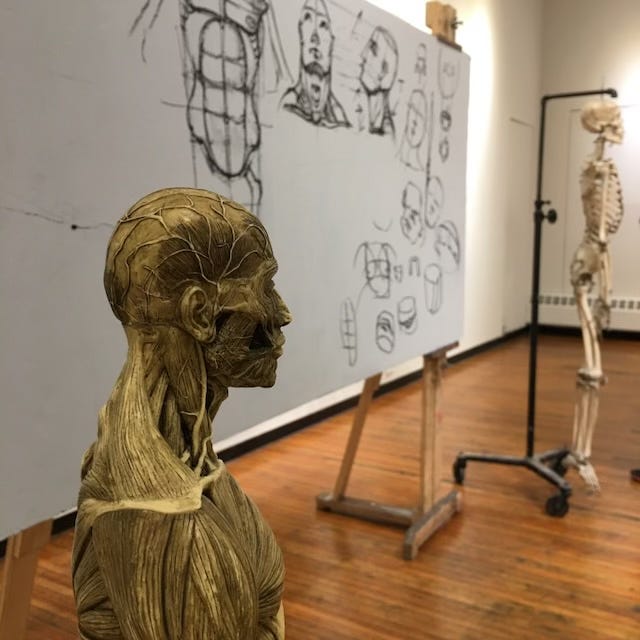
But a full-fledged diploma only matters if you're gunning for full-time professor gigs (and even then, adjunct pay rarely offsets six-figure loans). And better have that Master's. Ivory towers protect their own.
From a strict dollars-and-cents view, a four-year BFA usually loses to:
Two-year community college certificates
Trade schools with industry connections
Apprenticeships, bootcamps, or self-taught portfolio paths
I have a dear friend getting an associate's degree in illustration. Smart move. No core curriculum. No classes that are not IMMEDIATELY applicable professionally. Smart choice.
The Teaching Trap
Ever notice how some art or design professors seem disconnected from industry? There's a term for it. When graduates who haven't worked in the field start teaching it's called "academic inbreeding" (sometimes called "intellectual inbreeding").
Schools hire their recent alumni, creating what researchers call the "echo-teacher" problem—where techniques get copied, but real-world professional context? Never gets through the door. Workflow? What do these recent graduates know about workflow? Nothing, that's what. Tools matter little. Workflow does. I wish more people understood its importance.
Making Friends with ROI: A Simple Three-Step Plan
Get actual numbers, not vibes. Look up your target school in CEW's ROI tool (the 10 and 20-year views tell you the most)
Calculate what it REALLY costs. Add living expenses, wages you'll miss while studying, and interest if you need loans. Then subtract any grants or scholarships.
Test the no-degree path. Price out certificates, apprenticeships, or going straight to freelance. Compare where you might be in 10 years with each approach.
If the degree still wins after all that, good on ya! If not, you avoided an expensive mistake.
And here's the honest truth: art degrees aren't inherently bad investments. A $32,000 public school education can be a perfectly reasonable path. A $200,000+ education could be pure luxury, a private boutique experience. It is not for everyone. It's high-pressure and higher cost.
But like going to Harvard, it can be worth your pennies. Not every penny is worthwhile. Some classes are gonna suck. But in toto, it can be a reasonable investment. Elite schools hire elite educators. Students work alongside elite competitors/friends. Students might meet elite professionals. But $400,000 connections? If I bore the burden of that debt, I'd be an emotional wreck, crying myself to sleep every night. Then again, I might also have had a job with big pay. Ain't me. Just speculation.
Bottom Line: Red or Black
In 2025, running numbers isn't cynical—it's self-defense. Creative industries judge you on what you produce. Judgment is never based on a degree framed on your wall. Doesn't happen. Better make sure whatever tuition check you or your parents write delivers more than bragging rights.
And resist the temptation to cycle back into academia too soon. You need experience. Painful, earned, real-world experience.
Your passion deserves a plan.
Listen, I believe in education. But not at the expense of being permanently in debt.
Debt Kills Dreams.
Charles Merritt Houghton
29 May 2025