

♦♦ [STORY] Sizing Your Story: Optimizing for Single Issues and Trade Paperbacks
Are your stories naturally fat or lean? (Easter egg for my oil painters.) Match your narrative DNA to the perfect issue count, or watch readers abandon your series.

One of the most crucial decisions you'll make as a comic creator isn't about your characters or plot—it's about the size of your story. Before you put pencil to paper or fingers to keyboard, you need to answer a fundamental question: How long is your damn story?
Find Your Story's Natural Length
Every story has an inherent rhythm and size. Some tales are lean and focused, while others are expansive and complex. The key is recognizing which type of story you're telling before cramming it into standard format issue lengths.
Today's market offers three main options:
20-page issues (6 issues = standard trade)
24-page issues (5 issues = standard trade)
40-page issues (3 issues = standard trade)
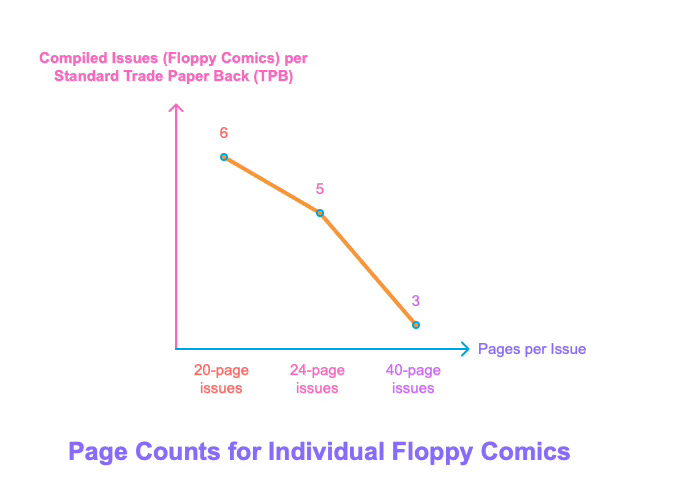
The Magic Number: 120 Pages
The standard trade paperback (TPB) is approximately 120 pages of story content. Hit this number. Use it to structure your narrative arcs efficiently. If you're printing your own comic, this number is not a hard and fast RULE, but it's still a great GUIDE. The printer will print whatever you like. However, the publishing industry has a history of making 120-page trade paperbacks, and readers are comfortable with the lengths. Worth considering.
Finding Your Format
Start by outlining your entire story arc. Then, divide it into natural breaking points for individual issues. Pay attention to how the content is distributed:
If your issues naturally run lean (18-20 pages of solid content), the 20-page format with a 6-issue arc is your best bet.
If your storytelling tends to be more expansive with many moving parts, the 24-page format with 5 issues might be your sweet spot.
The 40-page format with 3 issues could be ideal for ambitious stories that demand more breathing room per chapter.
Avoiding the Common Pitfall
The worst comics are those whose creators clearly didn't know if they were writing a 3-issue, 5-issue, or 6-issue story. You can spot them immediately: they either pad issues with unnecessary splash pages or cram too much content into too few pages.
Don't be that creator. Figure out your natural rhythm and optimize for it.
Embrace the Constraints
Contrary to what you might think, these constraints don't limit your creativity—they enhance it. Limitations act as a forcing function, pushing you toward bold, imaginative choices that might not emerge without boundaries.
When you know exactly how much space you have, you can make every panel count. Your story will gain focus, your pacing will tighten, and your impact on readers will intensify.
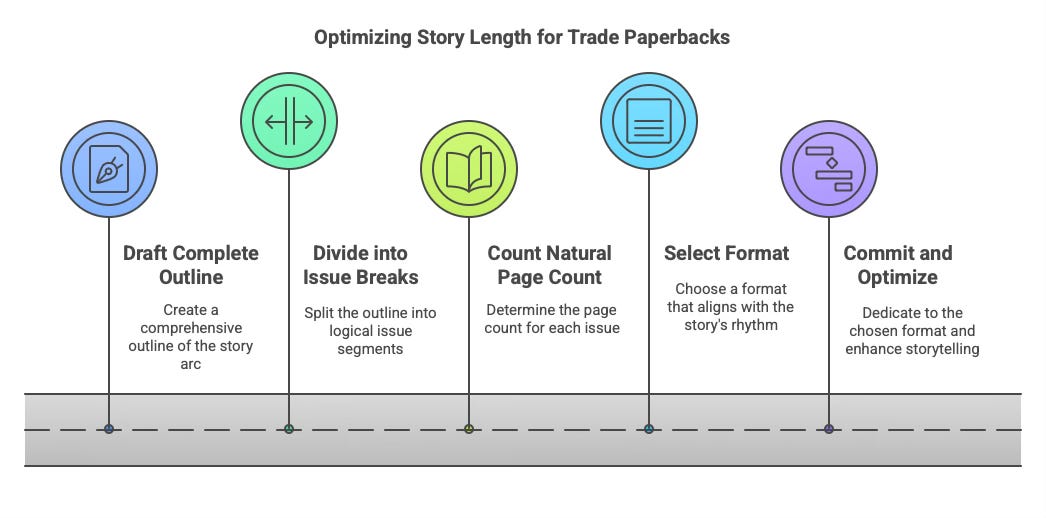
Your Action Plan
Draft a complete outline of your story arc
Divide it into logical issue breaks
Count the natural page count for each issue
Select the format that best matches your story's rhythm
Commit to that format and optimize your storytelling within it
Remember: Single issues need satisfying mini-arcs while contributing to the grander arc that ultimately forms your trade paperback. When you honor both the small and large structures, your story will resonate with readers in both formats.
The best comic creators aren't just great storytellers—they're architectural thinkers who understand that form and content must work harmoniously. If you size your story well, you'll master a critical aspect of comic creation.
Charles Merritt Houghton
14 March 2025