

♦[ART] Small Drawings, Big Problems: Why Starting Big Helps You Tackle Perspective
This week has been another great Perspective Workshop at ASL, but I have one note: working larger when learning perspective helps me help you. Happens to true for Figure Drawing, too.

If you’re trying to draw accurate perspective constructions but you’re doing it on an 8.5x11 sheet of printer paper, you’re setting yourself up for frustration. You’re fighting the drawing before you even begin.
Here’s why:
Drawing small feels efficient. But it’s a trap.
Small drawings give the illusion of speed and control. Less space = less time, right?
Wrong.
Perspective is not forgiving. Every missed intersection, every slightly tilted vertical, every line that almost converges but doesn’t quite — all of it adds up. Errors compound fast.
And when you’re working small, you can’t see those problems. Worse, I can’t see them either, which means I can’t help you fix them.
Working on a bigger scale gives you more space to learn. Mistakes happen. When learning linear perspective, they’re just the price of admission.
Big drawings slow down the rate at which errors accumulate. They give you margin for shaky lines. They let you see what’s happening — where your logic is off, where your vanishing points are drifting, where your construction is breaking.
Perspective rewards precision. But you need space to be precise. You must SEE your mistakes.
Here’s why working big helps, especially at the beginning:
Thin lines matter. Perspective is geometry. If your pencil is fat, your marks aren’t accurate.
Mechanical pencils make a difference. That’s why I hand them out for free. It’s a cheap tool.
Larger format = more accuracy. Working larger gives you more space to aim and more tolerance for error.
Mistakes become visible earlier. You don’t have to finish the whole drawing to realize it’s off.
It’s easier to hit intersections. Especially with rulers, dividers, and triangles.
Your undistorted area, within the cone of vision, is larger. A large overall drawing area means the undistorted area grows inside it.
Your teacher can actually help. I can read your thinking when your drawing gives me room to see it. Inevitably, I'm looking at your drawing whilst standing up. My eyes aren’t what they used to be. To analyze a drawing, I need to see it.
The fix that worked in my class:
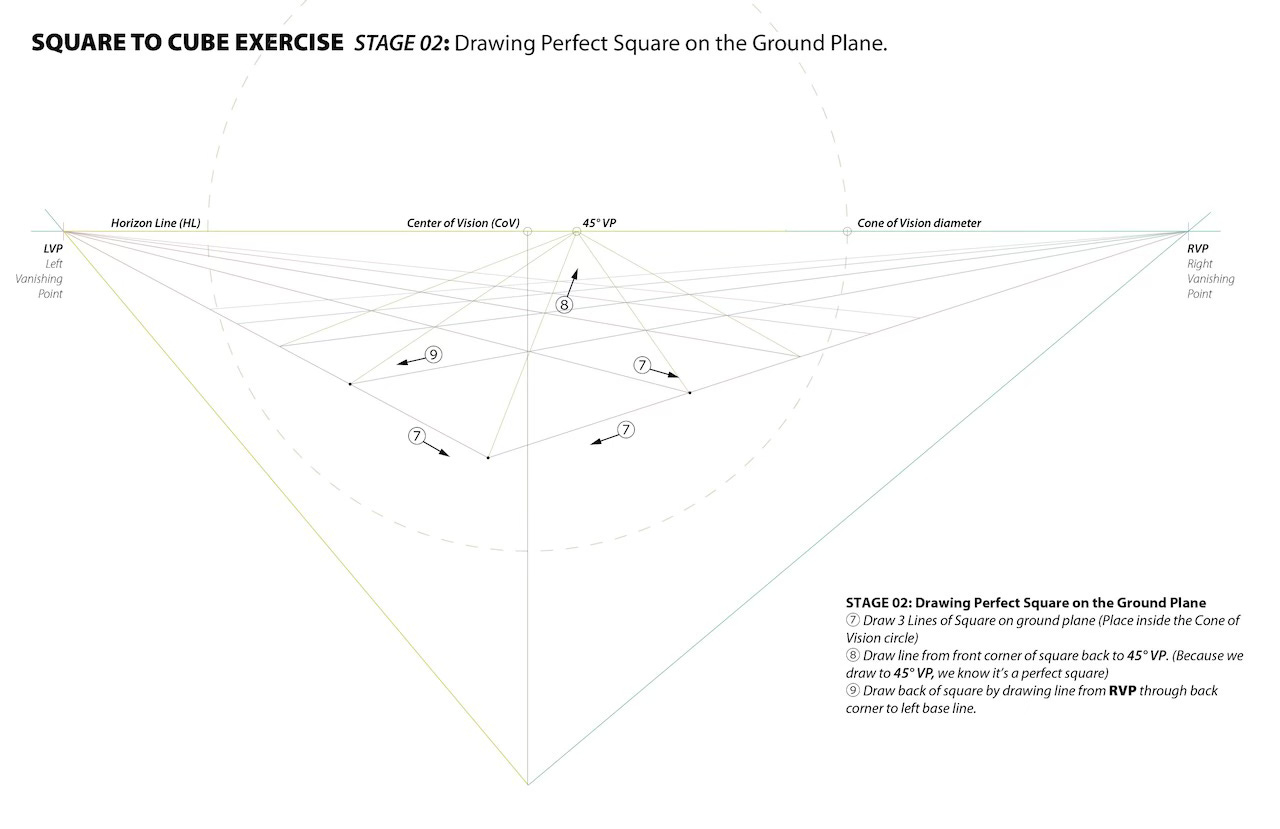
When I saw too many students getting stuck and working too small, I created standardized 11x17 printouts:
Shared vanishing points
Pre-marked horizon lines
Common station point
Now we were all working from the same armature, and I could diagnose problems.
Even better? Students could finally see their own mistakes. At least I hope that’s what happened.
But how big is big enough?
Work as large as your space allows.
Don’t go so big that your family can’t use the table.
But absolutely don’t settle for 11x8.5, that’s too small.
Aim for 11x17 or larger if possible.
Think of it as visual scaffolding; it’s temporary, but critical to building something solid.
Final Plea:
Perspective is a discipline of compound returns — or compound nightmares.
If you’re inaccurate early, it only gets worse as you go. Maintain as much precision as you can muster. If you work larger, your margin for error is wider..
But if you’re accurate early, you get clean, believable results fast.
So don’t fall for the false economy of working small.
Invest in big paper.
Invest in Space. Your working area matters.
Invest in your accuracy.
And most importantly, give yourself room to learn.
I enjoy working with students on their perspective constructions. We live in a visual world, and being able to show people what might be is a superpower.
But linear perspective ain’t easy, and it sure ain’t intuitive. It’s a high wire act, and the falls can feel painful. But, with a good safety net —such as a large working area, a deliberate pace, and accurate lines —your efforts will pay off.
Dedicated to my Perspective Students, past and present.
Charles Merritt Houghton
18 July 2025