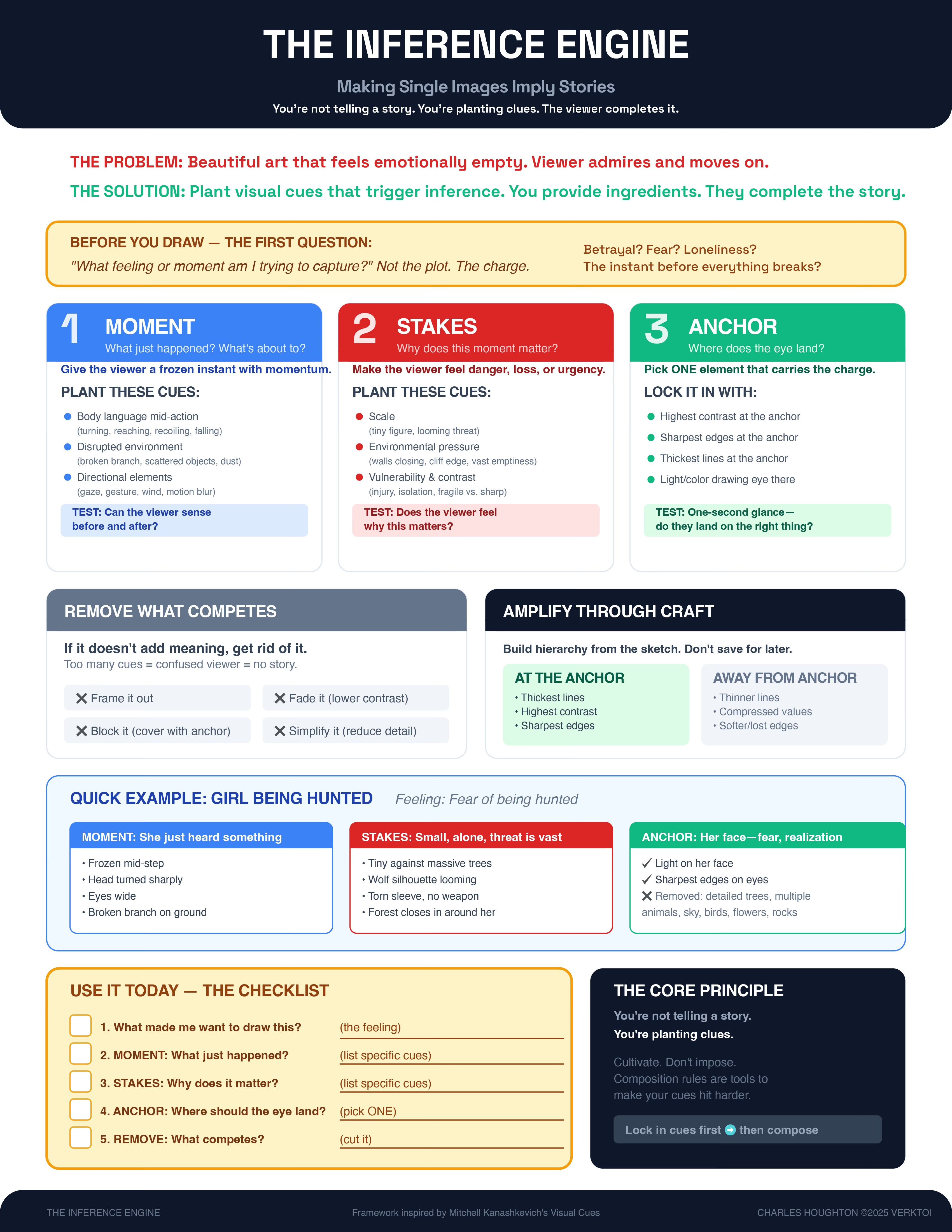
♦[STORY]The Inference Engine: Making Single Images Imply Stories
If you do your job, you might not tell a story... but your viewers might. Plant visual cues that trigger the viewer’s inference engine. You provide ingredients. They complete the story.

Quick Reference Guide to Single Image Visual Storytelling
The Problem: Beautiful art that feels emotionally empty.
The Solution: Plant visual cues that trigger the viewer’s inference engine. You provide ingredients. They complete the story.
Before You Draw: The First-Thing-Outta-The-Gate Question
“What feeling or moment am I trying to capture?”
Not the plot. The charge.
Betrayal?
Fear of being hunted?
Loneliness?
The instant before everything breaks?
This is your north star.
Three Steps to Evocative Imagery
STEP 1: MOMENT
What just happened? (or what’s about to?)
Give the viewer a frozen instant with momentum.
Plant these cues:
Body language mid-action (turning, reaching, recoiling, falling)
Disrupted environment (broken branch, scattered objects, dust settling)
Directional elements (gaze, gesture, wind, motion)
Test: Can the viewer sense before and after?
STEP 2: STAKES
Why does this moment matter?
Make the viewer feel danger, loss, or urgency.
Plant these cues:
Scale (tiny figure, looming threat)
Environmental pressure (walls closing, cliff edge, vast emptiness)
Vulnerability (injury, exhaustion, isolation, broken equipment)
Contrast (fragile vs. sharp, light vs. dark)
Test: Does the viewer feel why this matters?
STEP 3: ANCHOR
Where does the eye land?
Pick ONE element that carries the charge. Everything else supports it.
Lock it in with:
Highest contrast at the anchor
Sharpest edges at the anchor
Thickest lines at the anchor
Light/color drawing the eye there
Test: One-second glance—do they land on the right thing?
Discipline and Courage: Remove What Competes
If something doesn’t add meaning, get rid of it.
Frame it out
Fade it (lower contrast, softer edges)
Block it (cover with anchor elements)
Simplify it (reduce detail)
Too many cues = confused viewer = no story.
Amplify Through Craft
Don’t save this for later. Build it in from the sketch.
At the anchor:
Thickest lines
Highest contrast (darkest darks, lightest lights)
Sharpest edges
Most controlled marks
Away from the anchor:
Thinner lines
Compressed values (mid-tones)
Softer or lost edges
Simplified detail
Quick Example: Girl Being Hunted
Feeling: Fear of being hunted
MOMENT: She just heard something
Cues: frozen mid-step, head turned sharply, eyes wide, broken branch
STAKES: She’s small, alone, threat is vast
Cues: tiny against massive trees, wolf silhouette looming, torn sleeve, no weapon
ANCHOR: Her face—the fear, the realization
Hierarchy: light on her face, sharpest edges on her eyes, thickest lines on her head
REMOVED: Detailed trees, multiple animals, sky, birds, flowers, textured rocks
Result: Her face unmistakable, wolf looms, forest closes in
The Core Principle
You’re not telling a story. Cultivate. Don’t impose. You’re planting clues.
Composition rules aren’t the goal—they’re tools to make your cues hit harder.
Lock in your cues first. Then use composition to make them unmistakable.
Use It Today
What made me want to draw this? (the feeling/moment)
MOMENT: What just happened? (list specific cues)
STAKES: Why does it matter? (list specific cues)
ANCHOR: Where should the eye land? (pick ONE)
REMOVE: What competes? (cut it)
AMPLIFY: Thickest lines, highest contrast, sharpest edges at anchor
Will It Make Any Difference? maybe…
Decoration: Beautiful craft, no emotional charge, viewer admires and moves on
Evocation: Craft serves emotion, viewer completes the story, viewer remembers
Charles
Credit: Framework inspired by Mitchell Kanashkevich’s Visual Cues ideas for photography. His insight: you can control which cues you plant to power the viewer’s inference engine. You’re not relying on hopes and prayers, that they’ll “get it”—you’re engineering it.
For photographers: Mitchell Kanashkevich - “The Storytelling Myth”
For visual storytellers: Keep this reference handy.