

♦♦[ART] Perspective Demystified: 4 Perspective Choices for Maximum Visual Impact
Great perspective doesn’t happen by accident—it’s about making choices in the right order. This simple, four-step framework will show you how to set up your perspective for bold, captivating images.

Being Intentional as an Artist and Establishing Trust
As artists and designers, we often dive straight into setting up perspective without first considering why we're using it. This can lead to technically correct but emotionally flat work. It can also lead the opposite direction, beautiful atmospheric pieces that lack structural integrity. Regardless, your images must be believable to your viewers. Narrative work has a heavier lift than abstract work. It has to look like something to your viewer.
But visual structure isn’t about heavy-handed, all-over detail—it’s about putting critical information where it matters. When the underlying foundation is well-constructed, you have the freedom to simplify, soften, or exaggerate without losing the viewer’s trust. Without that clarity, the drawing or painting loses its tether to reality. I may look expressive but lack believability. The RIEP Framework helps you make intentional choices about perspective to align it with your artistic goals.
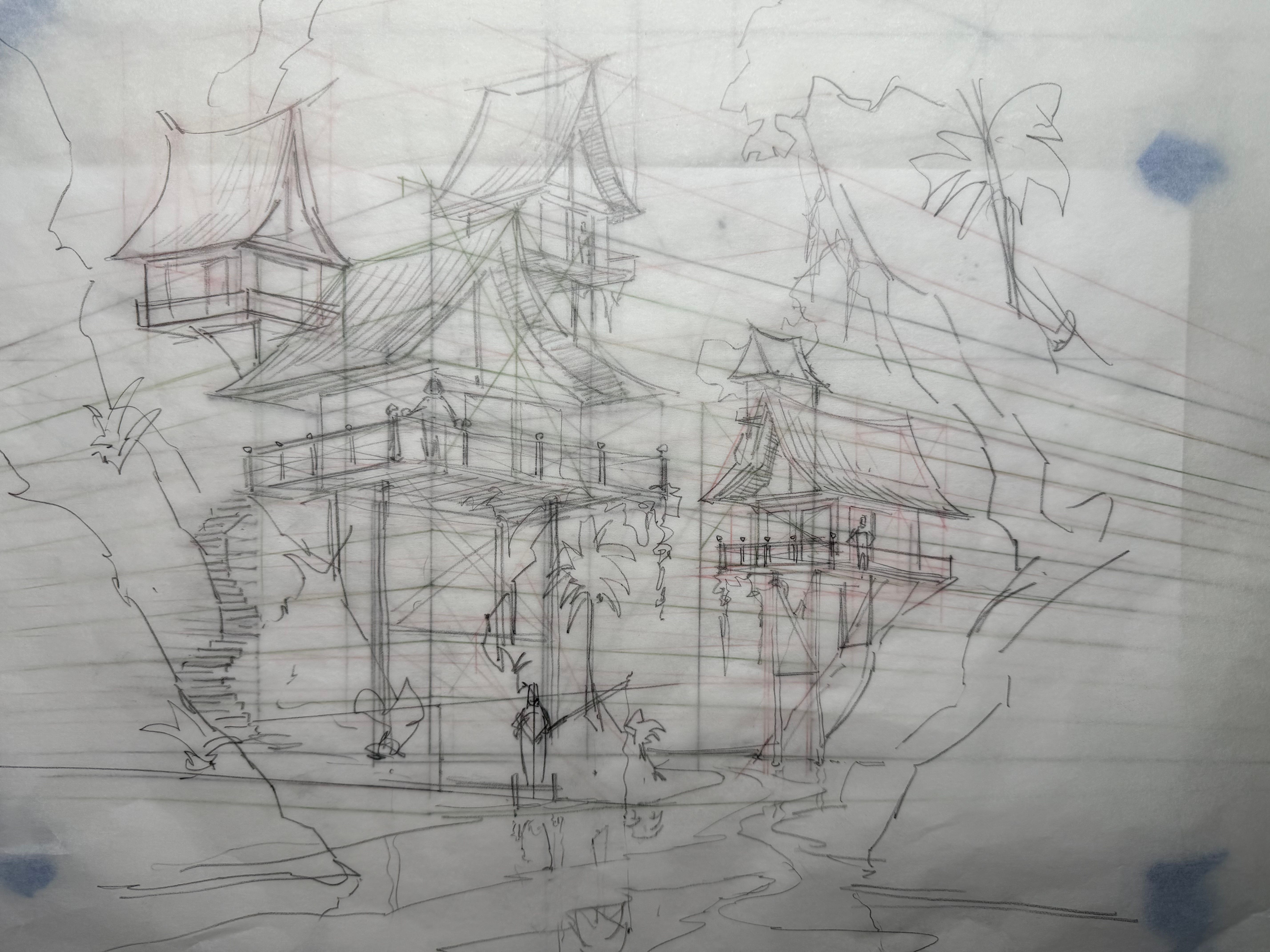
Why Fer’?
Imagine building a house without first deciding if it's meant to be a cozy cottage or an architectural wonder. When you draw without a goal in mind, you’re slapping up four walls and a roof without considering who’s going to live there. How rude. You’ll end up with a Rolls Royce in a shed or a goat in the ballroom. Intent matters. But what is your intent? Successful artworks begin with clear intentions. The RIEP Framework helps you make conscious decisions about perspective to support your artistic vision rather than approach it haphazardly. Your final piece should not be accidental.
The Best Artists are also Visual Surgeons
Mike Mignola’s spot blacks in Hellboy aren’t shortcuts—they’re delicate surgical cuts. Slivers of light dance among swathes of inky black. Each object in the panel meticulously reveals just enough of the underlying structure to be recognizable. The bones are there—perspective, form, and anatomy—but they’re tuned for maximum aesthetic and storytelling impact. His restraint doesn’t hide what’s missing; it amplifies what’s present. His balance of clarity and suggestion lures the viewer, triggering anxiety and creeping dread. It’s hidden in the reader’s imagination, but it’s also firmly grounded- the image stays believable. When the reader’s suspension of disbelief persists, the narrative trance remains intact. What more could you want?
The Framework Explained
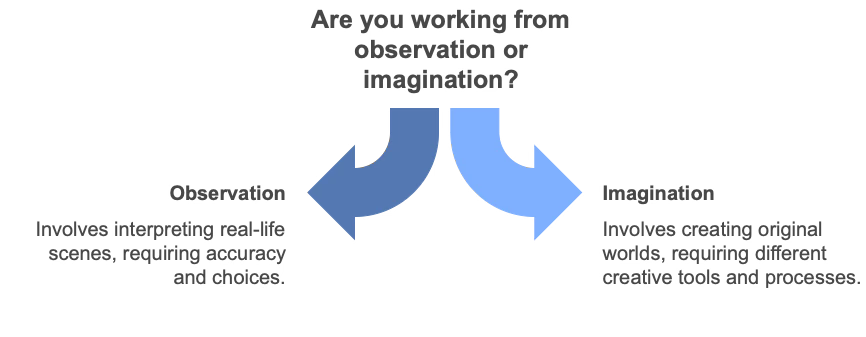
R - Real or Imagined?
Your first decision is fundamental:
Are you working from observation or imagination? When drawing from life, you interpret what you see, translating three dimensions into two. When working from imagination, you're building a world from scratch. It goes from neurons to the page. Each process requires different setups and different tools. If you’re a plein air painter, that drafting table and parallel rule ain’t gonna help… won’t fit in the backpack.
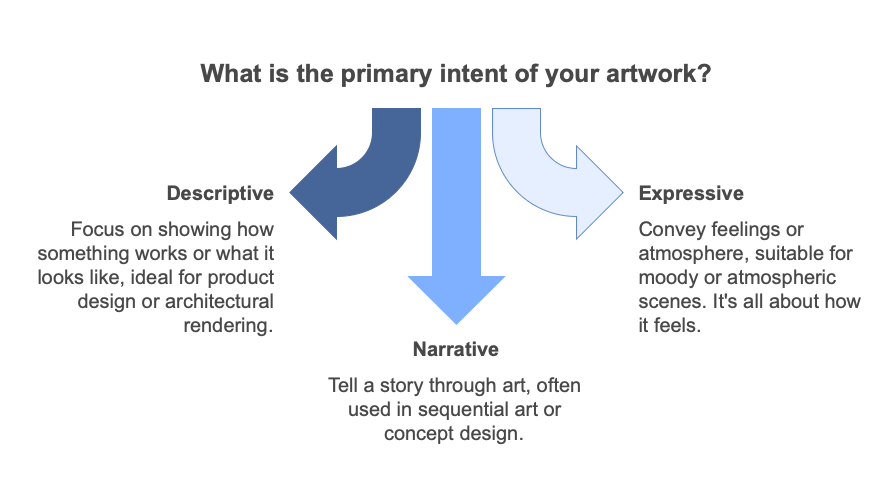
I - Intent (Descriptive/Expressive/Narrative?)
What's the primary purpose of your work?
Descriptive: You're showing how something works or what it looks like (think product design or architectural rendering)
Expressive: You're conveying a feeling or atmosphere (like a moody city scene)
Narrative: You're telling a story (as in sequential art or concept design)
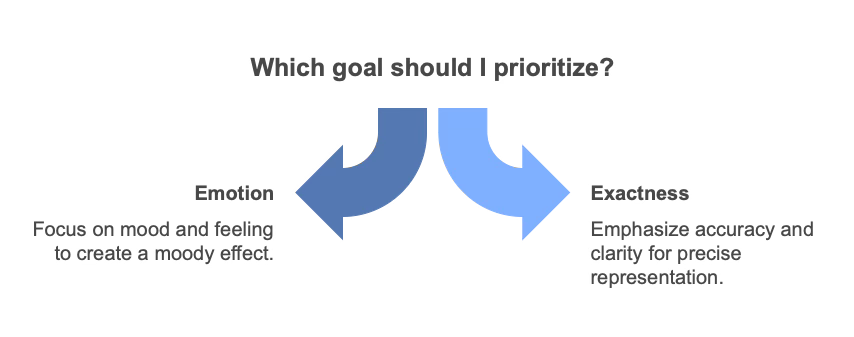
E - Emotion or Exactness?
Based on your intent, will you prioritize:
Emotion: Loose, atmospheric perspective that serves mood and feeling
Exactness: Precise, measured perspective that serves accuracy and clarity
P - Point of View
Finally, choose your technical approach:
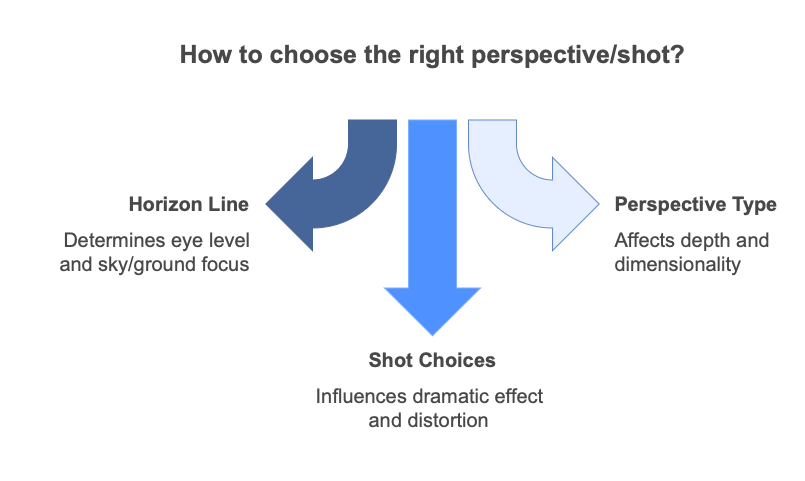
Horizon Line placement: Where is the camera? What is your eye level?
Low? You’ll see mostly sky.
High? You’re looking at something on the ground.
Eye Level? Maybe you’re looking into someone’s eyes.
Perspective type? (1, 2, 3, or 5-point) Which one serves you best?
Shot Choices: Viewing angle and distance. If your vanishing points are far away from the picture plane, you’re reducing the speed at which your depth lines converge. This creates a telephoto/flattening effect. Descriptive but less dramatic. If your vanishing points are close to the picture plane or even in it, your drawing will have more distortion. Dramatic but also discombobulating at times. Horses for courses, friends. (random equestrian reference)
What Happens Without This Framework
Without intentional decisions about perspective:
Product designers might create technically accurate but uninspired renderings.
Environment artists or landscape painters might create spaces that lack believability or a sense of depth and atmosphere.
Representational artists might miss opportunities to accurately capture key information or even enhance what they’re seeing for greater artistic effect.
Storytellers might choose perspective angles that work against their narrative. Or if they’re working with a team, maybe they’ve chosen an angle that puts a camera or lighting rig in an impossible location. Then, your team can make smarter decisions.
Making It Work: A Step-by-Step Guide
1. Before You Begin:
Take a moment to answer these questions:
Am I drawing what I see or what I imagine?
What do I want my viewer to understand or feel?
Which matters more - precision or feeling?
2. Setting Up:
For Real subjects: Position yourself based on your intent. Don’t love your vantage point? Walk somewhere else.
For Imagined subjects: Sketch thumbnails exploring different viewpoints. Quick composition sketches are key. It’s easier to scribble ideas quickly than it is to redraw a full grid with accurate lines and intervals in a better position.
3. Making Choices:
If your Intent is Descriptive: Favor exactness and clear viewing angles
If your Intent is Expressive: Choose dramatic or subtle perspectives that support your emotion
If your Intent is Narrative: Select perspectives that enhance your story
4. Implementation:
Choose tools that match your priority: Emotion or Exactness?
Set up your perspective grid with purpose
Layer in atmospheric perspective as needed. Control contrast, value, detail, texture, and color to focus your composition and add visual impact.
Key Concepts to Remember
Every perspective choice is an artistic choice
Your technical decisions should flow from your artistic intentions
It's okay to break perspective rules if it serves your intent
The framework is a guide, not a straitjacket - let your artistic intuition take the lead
Tying a Bow On It
The RIEP Framework isn't just about making better perspective drawings - it's about empowering you to make more intentional artistic choices. As you leave this workshop, remember that perspective is more than a technical tool - it's a powerful component of your creative expression. Use this framework to make conscious choices that serve your vision, whether designing products, creating environments, or telling stories through art. You are in control of your artistic expression. The Vanishing Points, sure as hell, aren’t.
Take perspective and make it your own. Bend it to your will. It’s a deep area of study. Just don’t go down the rabbit hole without a goal in mind. You’ll get lost in the tunnels chasing new tricks and techniques. Bring water and orange-cardamom cookies; you’ll need them.
Your perspective work will be more captivating and believable when you combine the HOW with the WHY. Understanding the technical aspects of perspective and the why was a magical moment for me. I grew. Maybe you’ll have similar moments in your journey. I hope so.
Now, go draw!
Charles Merritt Houghton
13 December 2024
I've updated per Hsien's query. Clarification should help.
I've updated the article to clarify the comment about "beautiful atmospheric pieces" made in the first version of the article.