

♦[STORY] Short Version: Three-Piston Character Engine Giving Stories Depth and Resonance
Riveting stories aren't always driven by better art or complex plots—it's about characters and their three-piston engine that drives stories - Wants, Needs, and Purpose. TL;DR version

Want to level up your stories? Getting beyond the surface wants of your character is a great way of adding depth. Want a satisfying character transformation? Take them from a self-destructive state of profound chaos and contradiction to one of synthesis and balance. How satisfying would that be?
The Three-Piston Character Engine:
Level 1: External Want (Plot Engine)
What your character actively pursues. This creates forward momentum.
The quickest storytelling fix: On a sticky note, write one clear sentence: "My character wants to _______." This must be evident within your first 3 panels.
Example: "Batman wants to stop the Joker from poisoning Gotham's water supply."
If you can't complete this sentence in specific terms, you've found why readers don't connect with your story. Fix this first! No exceptions.
Level 2: Internal Need (Character Engine)
What your character unconsciously requires to heal psychological wounds.
Below the Surface: Identify what your character believes about themselves that isn't true. This "sacred flaw" (as Will Storr calls it) creates internal conflict that deepens your narrative.
Example: Spider-Man wants to stop criminals (external want) but needs to forgive himself for Uncle Ben's death (internal need).
Level 3: Philosophical Purpose (Theme Engine)
Your character's existential quest for meaning and truth.
Going Deeper: What deeper wisdom must your character discover by story's end? This often contradicts both their initial wants and needs.
Example: Iron Man wants to protect the world with technology (external want), needs validation of his self-worth (internal need), but must discover the purpose of true sacrifice (philosophical purpose).
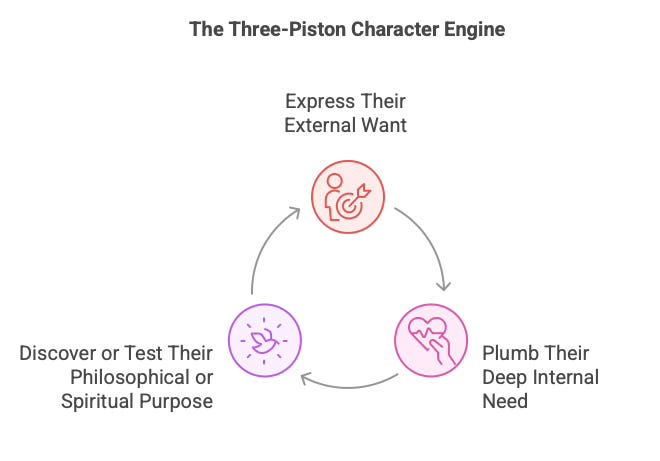
The Magic Formula:
The misalignment between these three levels naturally creates page-turning tension and anticipation. By the end of the story, these levels either align (a happy ending) or remain in conflict (a tragedy). Both are satisfying. It's up to you; be the storyteller you want to be.
Remember: External Wants provide motion, Internal Needs provide emotion, and Philosophical or Spiritual Purpose offers meaning. These aren’t the ONLY ways of giving stories motion, depth, and meaning, but they’re reliable ways of doing it.
Try this now: Take your current comic and identify all three levels for your protagonist. If any level is missing, you've got a ready-made plan for leveling up your storytelling. Warning: The shorter the story, the less real estate you've got for all three levels. A short story with obvious Wants is better than a muddy collage of all three. You need more pages to get all three levels working. Don't overstuff the turkey.
If you get all three pistons working, your stories will soar, and your readers will thank you—and possibly become your biggest fans.
by Charles Merritt Houghton